
Fields marked with an * are required
"*" indicates required fields
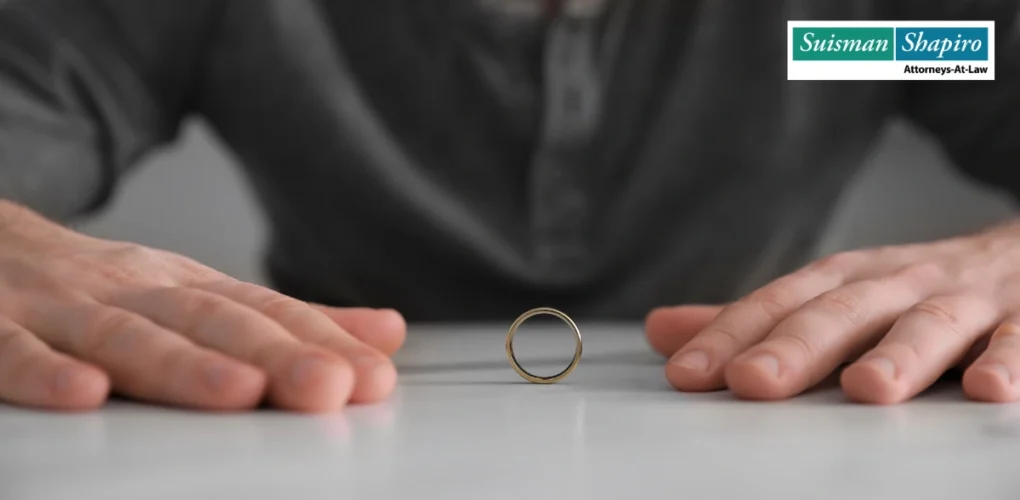
Knowing how to file for divorce in Connecticut involves more than mere paperwork. One must first determine that residency and grounds requirements are satisfied and then complete and file the appropriate court forms. In Connecticut, what we commonly call divorce is legally referred to as a dissolution of marriage. Suisman Shapiro Attorneys-at-Law can help you through this process.
Charles Suisman, Max Shapiro, and Louis Wool founded Suisman Shapiro Attorneys-at-Law. The firm has represented individuals, families, and businesses in eastern Connecticut for over 80 years and is currently the largest law firm based in eastern Connecticut.
The family law attorneys in Connecticut at Suisman Shapiro Attorneys-at-Law represent clients throughout New London, Norwich, Groton, Waterford, East Lyme, Stonington, Old Lyme, Old Saybrook, and other nearby communities from the New London office located at 75 State Street.
As reported by the Centers for Disease Control and Prevention, the divorce rate in Connecticut is 2.6 per 1,000 residents. Additionally, it is reported that 9% of men and 12% of women are divorced in the state. These divorced couples must meet certain requirements before a divorce can be finalized.
Connecticut statute allows a party to begin a dissolution of marriage action after either spouse meets state residency requirements. According to the law, the state residency requirement generally means that one spouse must have been a Connecticut resident for 12 months before the divorce paperwork is filed or before the court issues the divorce decree.
Exceptions to the general residency requirement can apply in cases where one spouse moved away from Connecticut after the marriage took place in the state, then returned with the intent to remain here, or when the cause for divorce occurred after either spouse established residency.
Connecticut recognizes both no-fault and fault-based grounds for divorce. A commonly used no-fault ground is that the marriage is irretrievably broken. This means that there is no reasonable prospect that the spouses may reconcile.
Fault grounds can be used as well, including grounds based on one spouse’s misconduct, such as adultery and intolerable cruelty. The selection of a fault-based ground for divorce requires evidence to support the allegation and could make the case more contested.
You must also determine if you and your spouse agree about the issues that must be resolved as part of the divorce. An uncontested case generally requires that the parties enter into an agreement addressing property and debts, alimony, and, if applicable, child custody and support. If the spouses cannot agree on issues, it becomes contested, requiring legal intervention.
When you hire a divorce lawyer, you have someone to draft and submit the required forms, address any procedural challenges, mediate a resolution, and stand in for you at court appearances. A Connecticut divorce attorney can also review proposed agreements involving property, debts, alimony, custody, and child support before you sign an agreement that becomes part of the final divorce order.
To start the process in Connecticut, you’ll typically use a standard initial filing package that consists of a Divorce Complaint/Cross Complaint and a Summons for Family Law Actions. When children are involved, the Affidavit Concerning Children also needs to be filled out and submitted.
You may be required to complete additional forms if you are requesting temporary orders during the case regarding matters such as child custody or support.
The completed paperwork is filed with the clerk of the Superior Court in the judicial district where you or your spouse resides. For those in the New London area, the courthouse address is 70 Huntington Street, New London, CT 06320.
Unless you are using the non-adversarial procedure, your spouse generally must be formally served with the divorce papers. The official service of these documents on your spouse can be performed by a state marshal, following all Connecticut legal requirements.
Your spouse can also waive service by signing the appropriate waiver. Once service is complete, the proof of service must be returned to the clerk of the court so the case can move forward. After this, you may proceed with the rest of the divorce process, including exchanging financial information, completing a parent education program, if needed, resolving lingering issues, and finalizing the divorce.
Yes, you can file for divorce without your spouse’s agreement. One spouse can file for divorce in Connecticut even if the other spouse does not want to end the marriage. Spouses’ disagreement may impact the case, including whether and how they may be able to resolve disputed matters. A contested divorce can require multiple steps before all issues are decided and finalized.
A spouse’s failure to respond does not always stop the divorce from moving forward. If properly served, the case can continue and be resolved even if the other spouse does not participate. If a divorce action is not resolved or otherwise completed in a timely manner, the court must still follow certain procedures before entering a judgment. There are often procedures available for seeking remedies when a spouse refuses to participate or misses deadlines.
It is sometimes possible to have a divorce case withdrawn if you and your spouse reconcile or otherwise decide not to continue. The process for withdrawing or otherwise terminating a pending case depends on its current procedural status, including whether the other spouse has filed a response or other documents with the court. If both spouses have decided they want to remain married, they should bring this to the attention of the court.
Yes. Spouses can use mediation to negotiate issues in dispute with the help of a neutral third party. The mediator does not represent either spouse and does not make decisions on their behalf. The mediator does, however, facilitate communication and negotiation about various topics such as finances, property, and parenting plans. If the spouses are able to reach an agreement, its terms are generally presented to the court and can be incorporated into the divorce process.
If you need help in your divorce process, Suisman Shapiro Attorneys-at-Law is here to help. Contact us today to get the legal assistance you need.

© 2026 Suisman Shapiro Attorneys-at-Law. All rights reserved.
Digital Marketing By: 
*Images are obtained under license from Canva and other third-party stock image providers, with attribution included where required.